
When Sex Was Never Enough
Back then sex with your partner wasn’t something you finished and felt satisfied with. It just switched you on harder.
You wanted your partner again. And again. You could go at it like two rabbits with no sense of time,
no pause button, no point where your body said “that’s enough.” One round didn’t calm you down,
it made you restless. You’d lie there already thinking about the next one. You’d look at your partner and feel that itch under your skin,
that constant hum that never shut up.
There was no such thing as enough. Hunger reset itself the moment it was fed. You didn’t want sex with your partner because it felt good.
You wanted it because stopping felt unnatural.
The Moment It Became “Normal”
Then things settled. You relaxed. You trusted each other. That was supposed to be the good part. Somewhere in there, sex stopped ambushing you and started waiting its turn.
It became polite. Predictable. Almost considerate. Same bed. Same time. Same quiet understanding that this is how it fits into life now.
Desire didn’t throw a tantrum or make a dramatic exit. It just clocked out without announcing it. Not because sex stopped feeling good, but because it stopped feeling urgent.
Nothing was at stake anymore. You knew it would be there tomorrow. Or the weekend. Or whenever it was scheduled to happen.
And once the brain learns that something is guaranteed, it stops reaching for it. It stops paying attention.
Certainty doesn’t excite the nervous system, it dulls it. Comfort creeps in, routine takes over, and suddenly sex is still there, still available, but somehow easier to postpone than to want.
How Attraction Turns Into Annoyance
Attraction doesn’t disappear overnight. It gets irritated first. You wake up next to your partner and instead of wanting them, you’re mentally negotiating space.
The snoring feels louder than it should. Their body heat is suddenly offensive. They steal the blanket like it’s a personality trait.
The little habits you once found endearing now feel like personal attacks.
Remember when you couldn’t start the day without them, five rushed minutes before work, half asleep and already late.
Now those same five minutes feel sacred for a different reason. Leave me alone. I need sleep. The laugh. The chewing.
The way they touch you when you’re clearly not in the mood but they somehow miss that every time. Psychologically, your brain has reclassified them.
No longer a stimulus, now just part of the scenery. Familiar. Constant. Inescapable. They didn’t stop being attractive, they just stopped being interesting.
Desire doesn’t survive on closeness alone. It needs interruption. Contrast. Space. Without that, attraction doesn’t explode into passion,
it decays into mild irritation and a strong urge to roll over and face the other side of the bed.
Why Less Sex Doesn’t Make You Want It More
Here’s the part nobody brags about. When sex gets rare, you don’t become more romantic. You become more efficient.
You adapt. You discover that imagination is reliable and doesn’t need mood lighting.
That five quiet minutes alone can solve the problem without scheduling, feedback, or emotional follow-up. Psychologically, this is exactly what the brain prefers.
It wants relief with the least friction possible. Partnered sex now comes with effort, timing, expectations, and the risk of it being “a thing.”
Solo solutions are fast, controlled, and mercifully uncomplicated.
So your mind starts choosing the option that asks less of you. Not because you stopped wanting sex,
but because you stopped wanting the process around it. “Not tonight” isn’t avoidance of pleasure. It’s choosing convenience over complication.
And once your brain learns that shortcut, convincing it to dress up desire and make a whole evening out of it feels unnecessary at best and exhausting at worst.
When Sex Becomes a Calendar Event
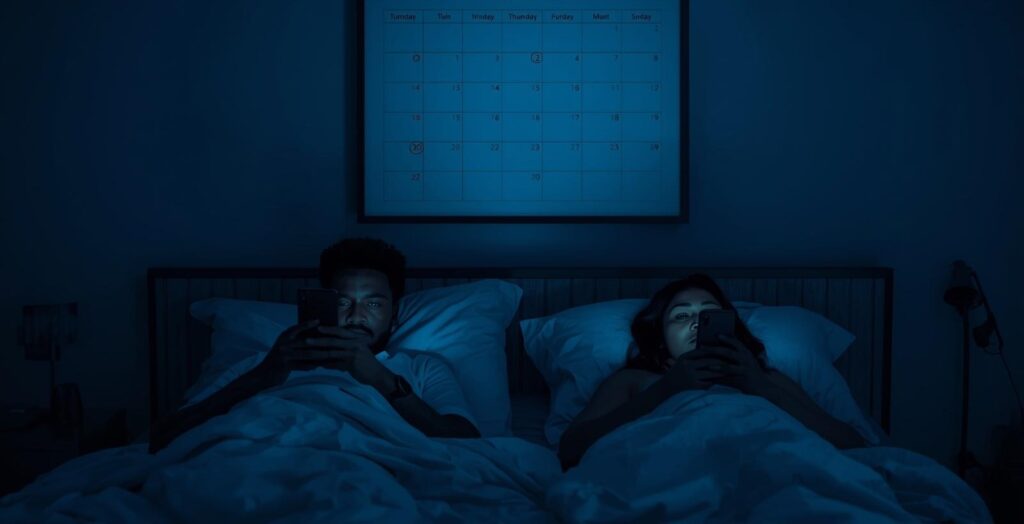
Eventually sex turns into a gift. Birthday sex. Christmas sex. The kind you unwrap carefully, knowing exactly what it is before you open it.
You go all in when it happens, you commit, you do your part, but it doesn’t hit the same place anymore.
You close your eyes more than you used to. Not because it’s bad, but because you’re focused. On finishing the task. On doing it right. To not disappointing the person lying next to you. It feels less like desire and more like a mission.
And the uncomfortable truth is your partner is probably doing the same thing, running their own quiet checklist, hoping you’re satisfied so they don’t have to talk about it afterwards.
Psychologically, this is what happens when sex loses spontaneity and becomes responsibility. Nobody is chasing anymore. Nobody is risking anything.
You’re both showing up out of care, not hunger. Comfort keeps the relationship alive, but it drains sex of danger, urgency, and pull.
And without that edge, sex doesn’t disappear. It just becomes something you both complete, politely, wondering why it didn’t feel like it used to.
How to Bring Sex Back to Life
- Stop using sex as relationship maintenance. Desire isn’t impressed by responsibility.
- Kill the schedule. If sex has a regular slot, your brain already marked it as optional.
- Create absence. Constant access turns people into furniture.
- Do fewer things together. Togetherness is great. It’s also excellent at murdering tension.
- Stop checking in like HR. “Are you in the mood?” is how desire files a complaint.
- Be a little inconvenient again. Predictability is comfortable. Comfort is a libido killer.
- Accept that safety made you boring. If nothing can be lost, nothing feels urgent.
- Sex used to interrupt your life. If it politely waits its turn now, don’t act surprised it stopped trying.
When sex turns into routine, people blame effort—but effort isn’t the problem. Safety is. And once you see how safety rewires attraction, the pattern becomes impossible to unsee → Why Desire Fades in Safe Relationships (Even When Nothing Is Wrong).
This isn’t about sex. It’s about how desire actually works—and why most advice quietly makes things worse. Subscribe if you want the parts people don’t say out loud, but feel every night when the lights go off.